
A Warli wedding starts with a wall. On the day of the ceremony, married women of the village paint a square of white figures onto the red mud wall of a hut, aiming to finish by evening. The painting stays under cloth until the bhagat, the community’s shaman, unveils it and checks that every one of the family’s deities has been painted in. Only then do the bride and groom pray to the mother goddess at its centre.
Almost everything now sold as Warli art, from the white-on-brown canvases at craft fairs to the dancing stick figures on cushion covers, grew out of that wedding wall. This guide covers how the wall painting works, what its shapes mean, how a farm labourer from Dahanu turned a women’s ritual into a gallery art, and what to check if you want to buy the real thing.
Who the Warli Are
The Warli live in the northern Sahyadri region of Maharashtra, mainly in Palghar and Thane districts around the taluks of Dahanu and Talasari. Smaller communities live in Nashik and Dhule, and across the border in southern Gujarat, Dadra and Nagar Haveli, and Daman and Diu. They speak Varli, a language with no written form, and most are farmers who grow a single paddy crop and supplement it with forest produce and a few animals.
The painting makes more sense once you know how recent the hardship was. Within living memory, many Warli families worked as sharecroppers or under begar, unpaid forced labour. Shamrao and Godavari Parulekar led a movement against that system in the 1940s, and begar was abolished by the early 1950s.
The Wedding Wall
A traditional Warli house is built on a frame of branches plastered with earth. The inside walls are coated with geru, a red clay, and in some villages with a wash of cow dung and water. The paint is nothing more than rice flour ground into a paste with water, bound with a little gum. The brush is a bamboo twig chewed at one end until it frays. There is one colour, white, on a brown-red ground.
The work divides by who does it and where. Married women, the suvasinis, paint the ritual motifs on the inside wall. Young girls paint decorative motifs on the outer walls and nearby surfaces.
The heart of the ritual painting is the chauk, a square (or rectangle) at the centre of the wall. In a wedding chauk, the mother goddess Palaghata sits in the middle as a symbol of fertility. Around her go the family’s gods, among them the five-headed Panchsirya, Narayan, Hiroba and Jhoting, along with the dhavleri who conducts the marriage rites, the bhagat, and the bride and groom on horseback. Outside the square, the wall fills with everyday life: farming, fishing, hunting, trees, birds, animals and dancers.
None of this is permanent. Mud walls weather and get replastered, and a painting lasts a few years at most.
What the Shapes Mean
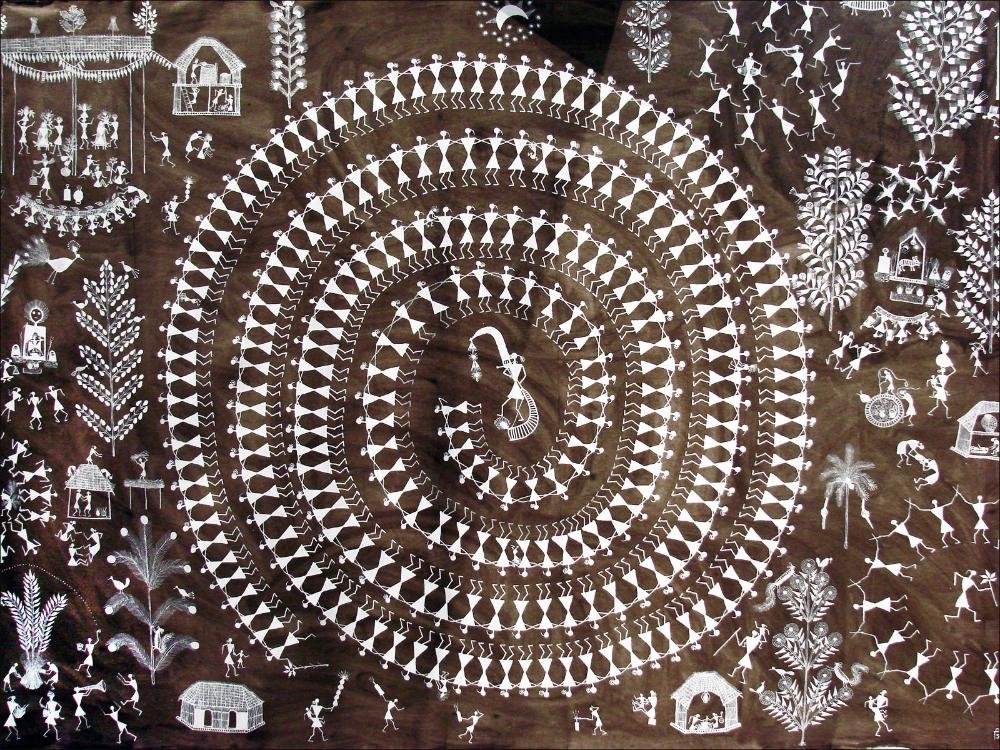
Warli painting uses a short vocabulary of geometry: the circle, the triangle, the square and the line. A circle stands for the sun or moon, a triangle for a mountain or tree, and a square for a sacred enclosure or a plot of land. The chauk is the square.
Bodies are built from triangles too. A human or animal figure is two triangles joined at their tips, one forming the torso and the other the pelvis, with thin lines for arms, legs and head. It looks too simple to work, until you see a whole ring of them dancing and notice how much movement a two-triangle body can carry.
That ring is the tarpa dance. The tarpa is a trumpet-like instrument that men play in turns, and the dancers circle whoever is playing. The ring is said to stand for the circle of life.
How Old Is Warli Painting?
You will find dates in print that run from the 10th century CE to 10,000 BCE. The scholar Yashodhara Dalmia has argued that the Warli carry on a tradition 2,500 to 3,000 years old, and some writers point to resemblances with the rock shelters at Bhimbetka. Others connect the Warli to a people named in Megasthenes’ account from the 3rd century BCE, though that match is a guess rather than a finding.
None of these can be tested. A painting on a mud wall does not survive for centuries, so there is no early Warli wall to date. What can be said is narrower and safer: the practice is old enough to be tied to weddings and harvests across many generations, and the version that reached galleries only took shape in the 1970s.
Jivya Soma Mashe: The Man Who Moved the Wall onto Paper
Jivya Soma Mashe was born in 1934 in Dhamangaon, in Talasari taluka, and moved at eleven to Kalambipada, a village in Dahanu. His mother died when he was seven. He is reported to have stopped speaking for several years afterwards and to have communicated by drawing pictures in the dust.
In the 1970s he was in his thirties and working as a farm labourer. By then a state effort led by the cultural activist Pupul Jayakar to revive declining indigenous arts had reached the Warli. Three Warli women were invited to a workshop in Delhi, and Jivya went along as their escort. He had painted as a hobby and was, in effect, the only man among women painters. The Mumbai artist Bhaskar Kulkarni, who had run a similar programme with Madhubani painters, encouraged him to paint on paper.
That changed two things at once. The surface moved from the wall to paper and later canvas, and the subject moved from ritual to ordinary life. Jivya painted the tarpa dance, farming, fishing and the blacksmith at work rather than gods. His canvases are crowded with dots and short strokes that make the figures seem to vibrate. “Life is movement,” he told Tribals Art magazine in 2001.
The exhibitions followed fast. His first was at Chemould gallery in Mumbai in 1975, organised by Kulkarni, and in 1976 he showed in Menton, France, and won a National Award. In 1989 he was one of the artists in Magiciens de la Terre in Paris, the same exhibition where Jangarh Singh Shyam showed Gond painting to a Western audience. Later came the Shilp Guru award in 2002, a joint show with the artist Richard Long at the Museum Kunst Palast in Düsseldorf in 2003, the Prince Claus Award in 2009 and the Padma Shri in 2011. He died in Dahanu on 15 May 2018, at 83.
He also trained six students, three girls and three boys. Only the boys carried on.
From Hut Wall to Gallery Canvas
That split shaped the art that followed. Warli painting today is largely a male profession. Sahapedia notes that married women still draw the opening lines of a ritual chauk, while the rest is often left to male painters.
Jivya’s son Sadashiv Mashe, born in 1958, carries on his father’s practice, as does his brother Balu. Balu Dumada, born in 1967 in Ganjad, was Jivya’s first student. Rajesh Chaitya Vangad, born in Ganjad in 1975, learned first from his mother, Ladhki Devi, and then from Jivya. Vangad’s work was shown at documenta 14 in Kassel in 2017, and the Tate Modern holds his paintings. Their canvases still run on the same triangles and circles, but the subjects have widened. Naag Panchami (2014), Vangad’s painting in synthetic polymer paint and mud on canvas, shows white ants moving in circles. The brothers Mayur and Tushar Vayeda, from the next generation, use the same visual language to address environmental and social concerns.
How a Warli Painting Is Made Today
Artists who paint for sale usually swap the mud wall for cloth, paper or canvas. According to Daily Art Magazine, Jivya himself moved from chewed bamboo sticks and rice paste on prepared walls to brushes on paper and canvas, and later worked on raw canvas with cow dung and acrylic. Vangad uses water-based colour on cloth, and for Naag Panchami he used mud alongside synthetic polymer paint.
White is still the default. Ojas Art describes Vangad’s compositions as monochromatic, and the white-on-dark look is what buyers tend to recognise as Warli.
Women Taking the Brush Back
The ritual chauk is still women’s work in the villages, and some women have pushed it back into view. The Better India reports on the Dhavaleri group in Palghar, which has trained 30 girls since 2019 and completed 19 chowks. Its members include Suchita Kamdi, who learned the art from her grandmother, and Kirti Nilesh Vartha.
The group’s best-known commission was a mural for International Women’s Day on 8 March 2022 at the Collector’s Office in Palghar. It paid ₹60,000. A traditional village chowk, by the same account, pays ₹1,200 to ₹1,500.
What the GI Tag Does and Doesn’t Cover
Warli painting has held a Geographical Indication since 2014. The registered proprietor is the Adivasi Yuva Seva Sangh of Waghadi village in Dahanu taluka. The application was filed on 7 June 2011, the certificate was issued on 31 March 2014, and it runs until 6 June 2031. The registered area covers Maharashtra, Gujarat, Dadra and Nagar Haveli, and Daman and Diu.
A GI protects the name. It means a work sold as “Warli painting” should come from that region. It does not stop a factory elsewhere from printing Warli-style figures on a tote bag, and it says nothing about whether any given piece was painted by hand.
Buying Warli Art: What to Check
Ask who painted it. A named artist from Dahanu, Talasari, Jawhar or the Ganjad area is the strongest sign of an original. A seller who can only say “tribal artists” probably cannot name the painter.
Look at the white line. Hand-painted linework wavers slightly, with places where the paste pooled or thinned. A print repeats exactly, and the same figure will appear in the same pose each time it shows up.
Match the price to the labour. A village chowk pays ₹1,200 to ₹1,500, and the Warli-focused platform Rooftop puts small certified originals at around ₹8,000 and major signature paintings above ₹1 lakh. A large “hand-painted” piece for a few hundred rupees should make you suspicious. Either it is a print, or the painter was paid far less than the work took.
Warli Painting Timeline
- 1934: Jivya Soma Mashe is born in Dhamangaon, Talasari taluka.
- 1970s: A revival effort led by Pupul Jayakar reaches the Warli, and Mashe begins painting outside the wedding ritual.
- 1975: Mashe’s first exhibition, at Chemould gallery in Mumbai.
- 1976: He shows in Menton, France, and wins a National Award.
- 1989: He takes part in Magiciens de la Terre in Paris.
- 2002: Shilp Guru award.
- 2009: Prince Claus Award.
- 2011: Padma Shri. In the same year, on 7 June, the Warli GI application is filed.
- 2014: The Warli painting GI is certified on 31 March.
- 2017: Rajesh Chaitya Vangad shows at documenta 14 in Kassel.
- 2018: Mashe dies in Dahanu on 15 May.
- 2022: The Dhavaleri group paints the Palghar Collector’s Office mural on 8 March.
Frequently Asked Questions
What is Warli painting?
Warli painting is the wall art of the Warli people of Maharashtra and neighbouring parts of Gujarat. It uses white rice paste on red mud walls and builds every image from circles, triangles, squares and lines.
What do the circle, triangle and square mean in Warli art?
A circle stands for the sun or moon, a triangle for a mountain or tree, and a square for a sacred enclosure or plot of land. Human and animal figures are two triangles joined at the tips.
What materials are used in Warli painting?
Traditionally, rice flour paste with a little gum, applied with a chewed bamboo twig onto a wall coated with red clay. Modern artists also use acrylic or other synthetic paint on cloth, paper and canvas.
Who is the most famous Warli artist?
Jivya Soma Mashe (1934 to 2018), who took Warli painting from the wedding wall to paper and won the Padma Shri in 2011. His students and family, including Balu Dumada, Sadashiv Mashe and Rajesh Chaitya Vangad, are the best known painters working today.
Does Warli painting have a GI tag?
Yes. It was registered in 2014 to the Adivasi Yuva Seva Sangh, covering Maharashtra, Gujarat, Dadra and Nagar Haveli, and Daman and Diu.
How is Warli different from Gond painting?
Warli is white geometry on a dark ground, built from a handful of shapes. Gond painting from Madhya Pradesh is colourful and filled with dots and fine lines inside each animal and figure. Our guide to Gond art covers the difference in detail.
Warli is one of eighteen traditions in our complete guide to Indian tribal art. For related traditions, read about Bhil and Pithora art, or browse our collection of authentic, artist-attributed Gond paintings.