
India has more than 700 recognised tribal (Adivasi) communities, and a striking number of them have their own art tradition — painting, metalwork, weaving, embroidery — passed down without formal training, tied to nature, ancestor worship and oral storytelling rather than to a temple or a royal court. That’s the line that separates tribal art from folk art: folk traditions like Madhubani or Pattachitra come out of settled agrarian communities and are usually religious or decorative in purpose, and are named after the region where they’re made. Tribal art is named after the tribe itself, tends toward a more minimal visual language — repeating lines, dots and geometric shapes — and is as likely to depict a deer or a harvest ritual as a god.
Most marketplaces lump the two together under “Indian folk art,” which is fine for browsing but blurs a real distinction. Below are thirteen tribal painting traditions and five craft traditions still practised in India today — some, like Gond and Warli, well known and commercially healthy; others, like Jadopatia and Chittara, kept alive by a handful of families and at real risk of disappearing within a generation. Documenting all of them, including the ones we don’t sell, is part of the point: these traditions only survive if people keep learning about them and asking for them by name.
Gond Painting — Madhya Pradesh
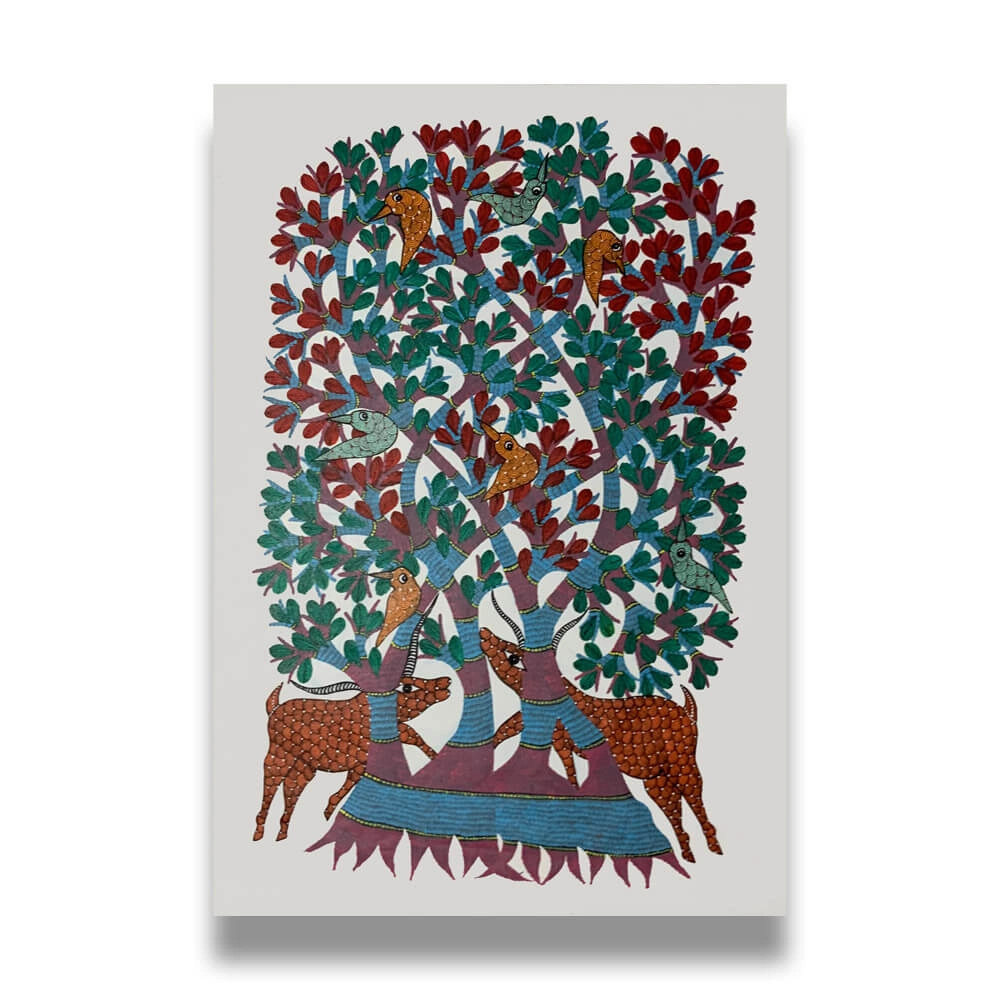
The Gond are one of India’s largest indigenous communities, spread mainly across Madhya Pradesh with pockets in Chhattisgarh, Maharashtra, Odisha and Andhra Pradesh. Gond painting began as a wall and floor mural made for festivals, using natural pigments from cow dung, mud, charcoal, and plant matter. Its signature look comes from filling every contoured shape — an animal, a tree, a human figure — with fine dots, dashes or short lines; each artist develops their own personal fill pattern, almost like a signature.
The move from mud walls to paper and canvas happened in 1981, credited to the artist Jangarh Singh Shyam, whose style (now called Jangarh Kalam) is the basis for most Gond art sold today. His work has been exhibited at the Smithsonian and London’s Victoria & Albert Museum. Gond painting from Madhya Pradesh received a Geographical Indication (GI) tag in April 2023, with Patangarh village in Dindori district recognised as its traditional home.
Bhil Painting — Madhya Pradesh, Gujarat, Rajasthan
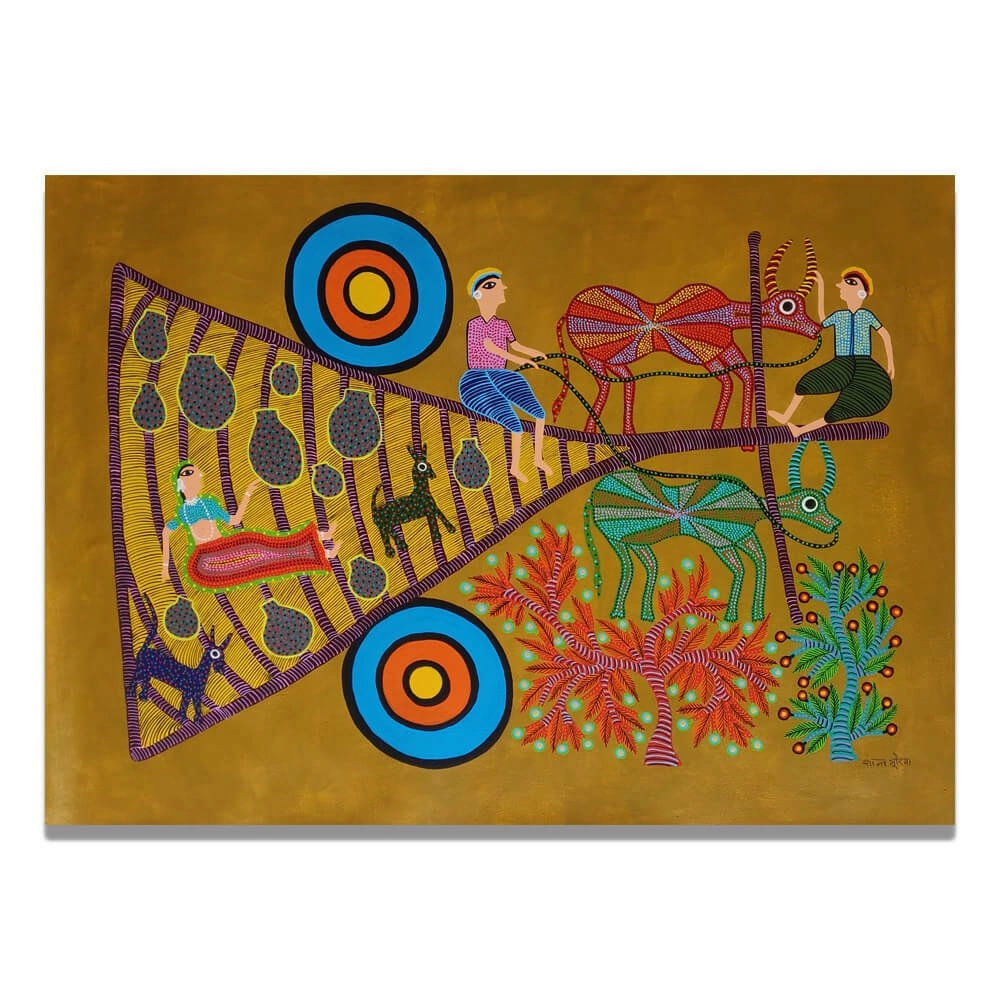
The Bhil are among India’s largest tribal groups, found across Madhya Pradesh, Gujarat, Rajasthan and Maharashtra. Where Gond art uses dots, dashes and lines together, Bhil painting is built almost entirely from dots — a pattern said to be inspired by kernels of maize, the Bhil community’s staple crop. The dots can be scattered loosely across the canvas or arranged in tight formation, giving the finished work a more naive, unrestrained feel than the precise, proportionate figures of Gond art.
Subject matter draws on the same well as Gond art — the sun and moon, animals, trees, rivers, deities and daily life — but Bhil painting tends toward brighter, more varied colour, rather than Gond’s black-dominant fill work.
Pithora Painting — Rathva, Bhilala and Bhil Communities, Gujarat & Madhya Pradesh
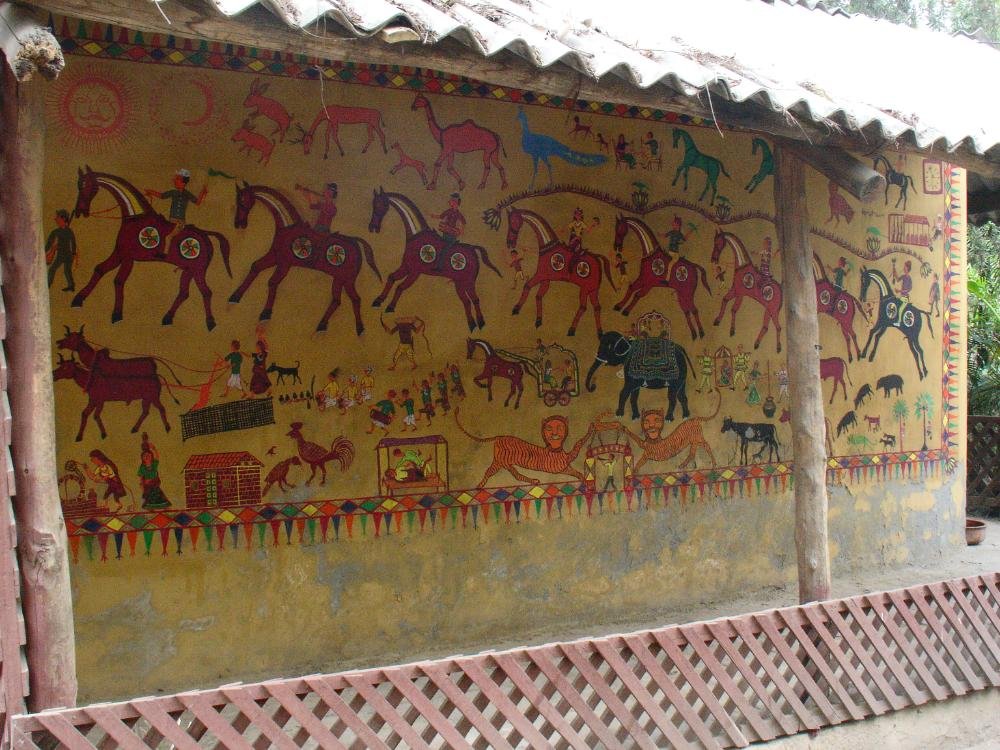
Pithora isn’t decorative art first — it’s a ritual. A Pithora painting is commissioned by a household for a specific purpose (to invoke prosperity, mark a wedding, remove obstacles) and painted directly onto the interior walls of the home, guided by a ritual specialist called a badva and executed by trained painters known as lakharas. The central motif is always the horse, standing in for gods, ancestors and spiritual power — traditionally seven horses, referencing seven sacred hills.
The style differs by region: in Gujarat’s Chhota Udaipur and Panchmahal districts, the Rathwa community paints elaborate, ornamented processions of horses and riders; across the border in Madhya Pradesh’s Dhar and Jhabua districts, Bhil and Bhilala artists paint a starker style closer to rock art, with triangles joined at the apex forming human and animal figures. Some of the earliest known horse-and-rider motifs in the region, at Koraj hill, have been dated to roughly 12,000 years ago. Pithora painting received its GI tag on 14 September 2021, and was back in the news as recently as July 2026 for the boost it’s giving artisan livelihoods in the region.
Baiga Art — Madhya Pradesh, Chhattisgarh
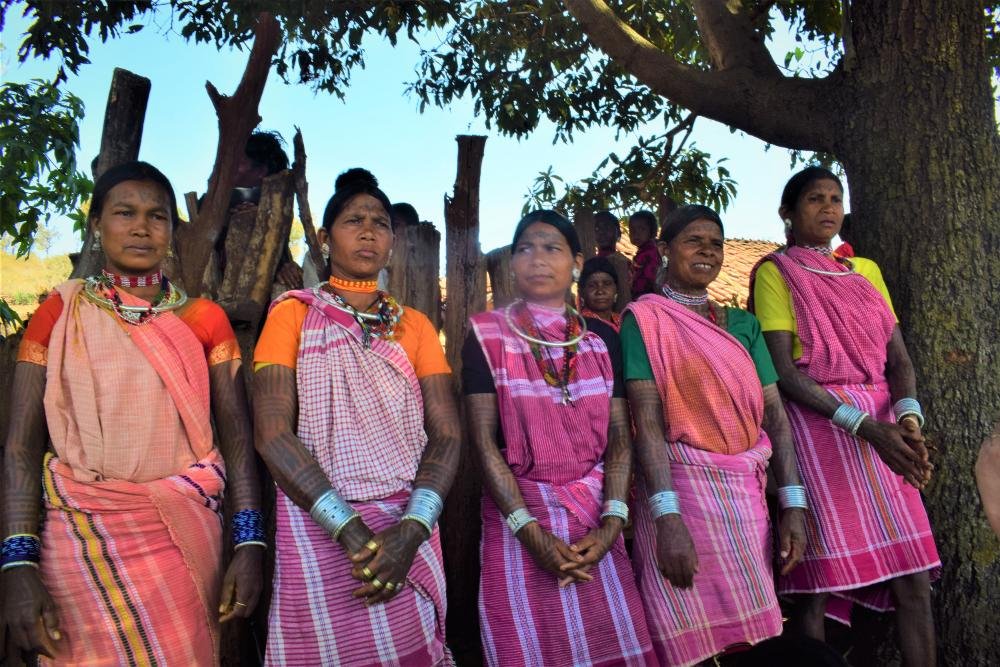
The Baiga are a forest-dwelling community concentrated in the Mandla, Dindori, Balaghat and Seoni districts of Madhya Pradesh, who traditionally reject plough agriculture out of reverence for the earth as a mother deity — a belief central to how they see their own art. Baiga art takes two forms. The older and better documented is Godna, a tattoo tradition practised by Baiga women: geometric, symmetrical patterns applied in stages across a woman’s life, starting on the forehead around age nine or ten and finishing on the chest after childbirth, inked with soot from crushed Ramtilla (niger) seeds. The belief behind it is direct — Godna marks are the one thing a person carries with them beyond death. The tradition is fading with younger generations, and few artists still practise it.
The second form is wall and, more recently, canvas painting, built from the same nature-first worldview — animals, trees and tribal legend rendered in earthy, natural pigments. This side of Baiga art gained wide recognition recently through Jodhaiya Bai Baiga, a day labourer from a village near Umaria who took up painting for the first time at around 69 after joining a free open art class run by Ashish Swami, a Santiniketan-trained teacher who became her mentor. She has since exhibited in Paris and Milan, received the Nari Shakti Puraskar from the President of India in 2022, and was awarded the Padma Shri in 2023. Baiga art does not currently hold a GI tag.
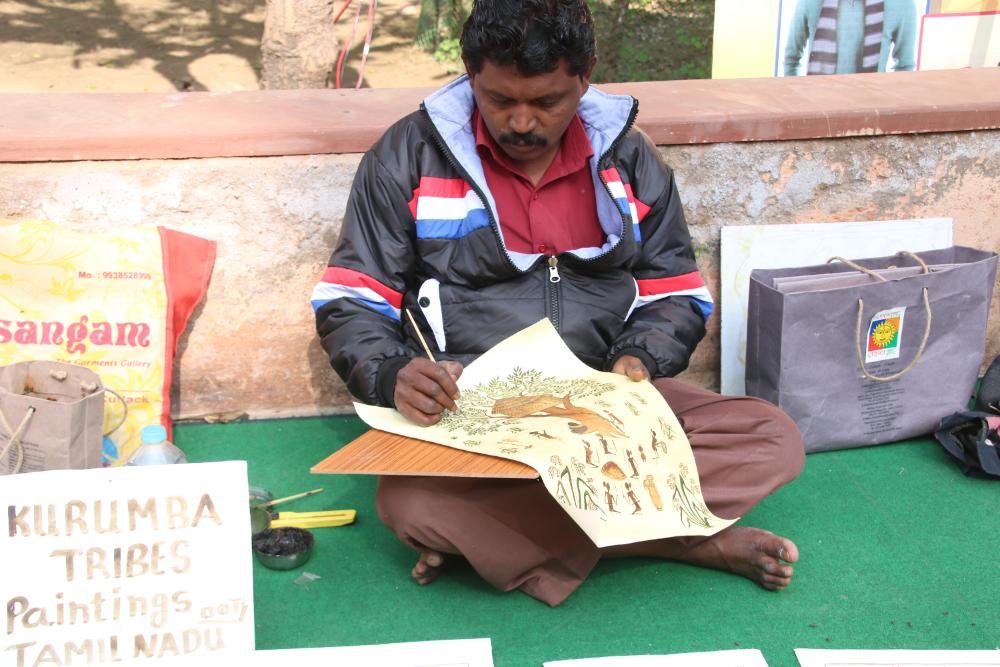
Kurumba Painting — Tamil Nadu
The only major tribal painting tradition from South India, Kurumba painting is practised by the Alu Kurumba, a Particularly Vulnerable Tribal Group living in the Nilgiri Hills. It’s also the oldest tradition on this list by far: the style traces back to prehistoric rock art in caves like Eluthu Paarai near Kotagiri, and documented references to it being painted on the walls of Kurumba dwellings go back to an 1873 colonial-era survey. The palette is earthy — red ochre and white, from local soil, leaves and stone, applied with brushes made from burnt twigs — and the subjects are daily life: honey collection, cattle herding, local wildlife, ritual.
The tradition nearly disappeared before being deliberately revived and carried onto canvas by the artist R. Krishnan of Velaricombai village, who died in March 2025 and was posthumously awarded the Padma Shri, India’s fourth-highest civilian honour, in 2026 for his work preserving it. There’s no GI tag protecting Kurumba painting yet.
Warli Painting — Maharashtra
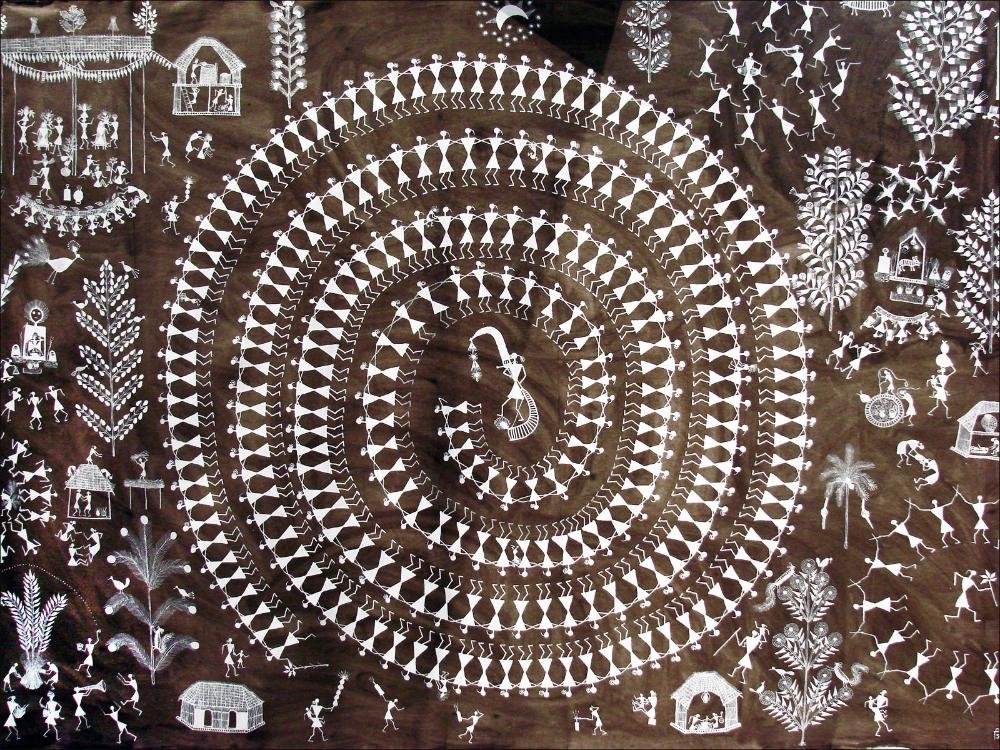
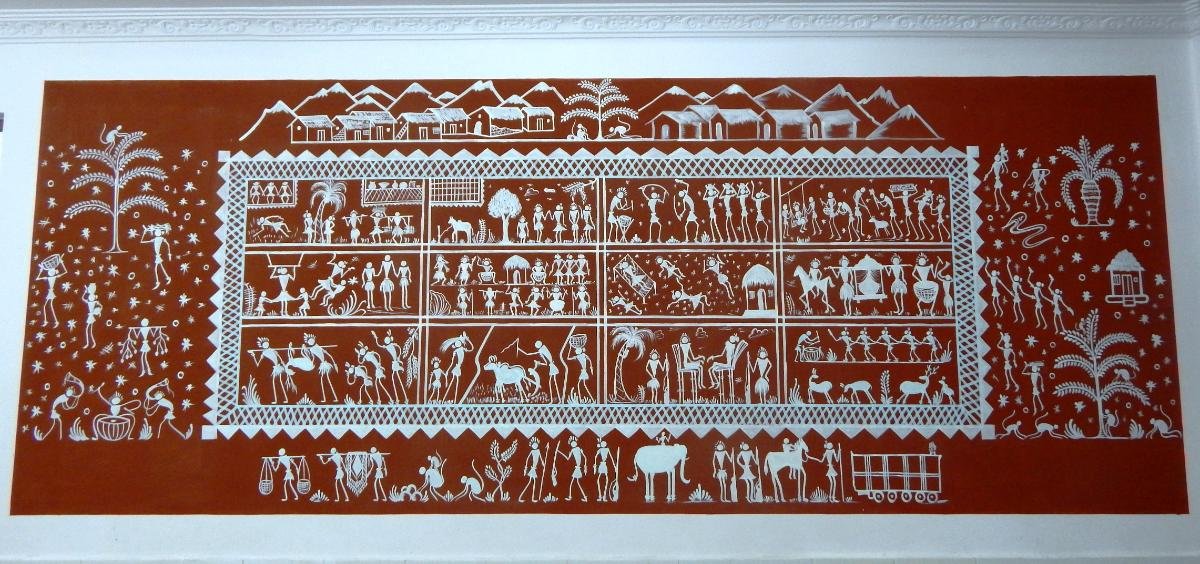
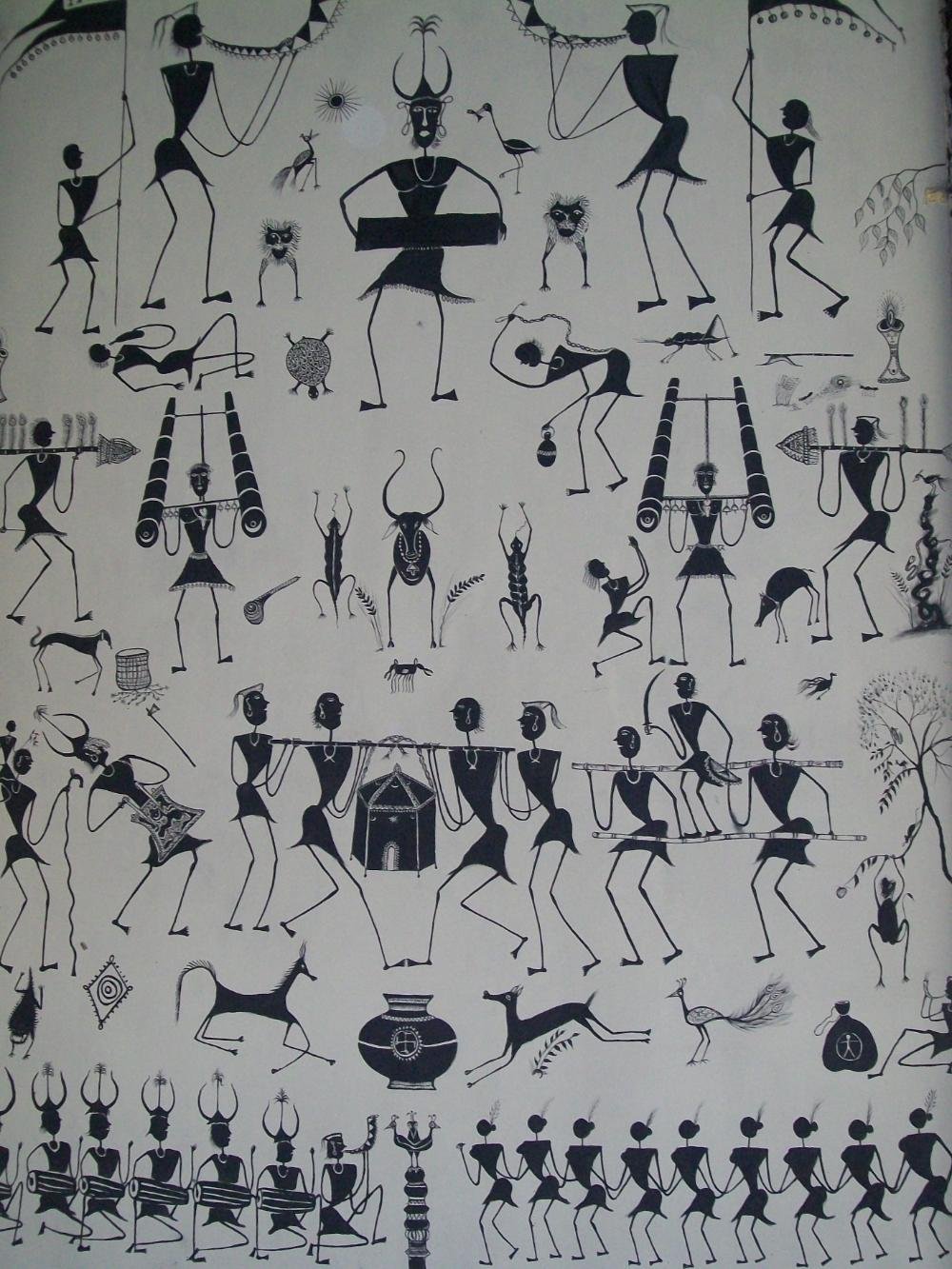
The Warli tribe has lived in the northern Sahyadri hills of Maharashtra, around what are now Thane and Palghar districts, for at least 2,300 years — some scholars trace written references to the community back to the 3rd century BCE. Warli painting is instantly recognizable: white pigment, made from ground rice paste, applied with a chewed bamboo stick onto a base of red geru (earth) plaster. No other colour is used.
The entire vocabulary is geometric — circles for the sun and moon, triangles for mountains, and two triangles joined at the tip to represent a human or animal figure, torso above and pelvis below. Traditionally painted by women to mark weddings and harvests, Warli art received its GI tag in 2014, protecting the name for artists working in its home districts.
Saura (Lanjia Saura) Painting — Odisha
Practiced by the Lanjia Saura tribe of southern Odisha’s Rayagada, Koraput, Ganjam and Gajapati districts, Saura painting — also called Idital — is among the oldest tribal art traditions in India, with roots in the region’s Austroasiatic culture. Like Pithora, it’s ritual rather than decorative: a family commissions a specific painting to mark a healing, a birth, a death, a harvest, or to honour ancestors, and it’s created by a trained ritual specialist called an Ittal Maran, who says the composition comes to them in dreams.
Recurring elements include the Tree of Life at the centre, the sun and moon as witnesses, horses carrying ancestral spirits, gender-neutral human figures shown mid-ritual or mid-task, and a fish-net pattern bordering the entire composition.
Santhal Painting — Jharkhand, West Bengal, Bihar, Odisha
The Santhal are India’s third-largest tribal community, and their painting tradition is traditionally done on cloth (pata) using natural pigments from plants, mud and charcoal. Scenes of daily life — farming, dance, festivals, hunting — are framed by decorative floral borders. Colour palettes vary by sub-region: Santhal Pargana work tends toward a restrained white, black, blue and red, while paintings from the Chotanagpur Plateau use a broader range including yellow. The tradition was studied and actively revived by Rabindranath Tagore, who introduced Santhal painting techniques at Shantiniketan.
Sohrai & Khovar Painting — Jharkhand
Around Hazaribagh in Jharkhand, women of the Santhal, Munda, Oraon and Kurmi communities practice two related but distinct mural traditions on mud walls. Sohrai is freehand and colourful, painted after the harvest, in the weeks following Diwali. Khovar is monochrome and made for weddings, created with a distinctive comb-cut technique that scrapes a design into a wet plaster surface to reveal a contrasting layer beneath. Sohrai-Khovar received Jharkhand’s first-ever GI tag in 2020, reportedly one of the fastest approvals on record at around nine months from application to certificate.
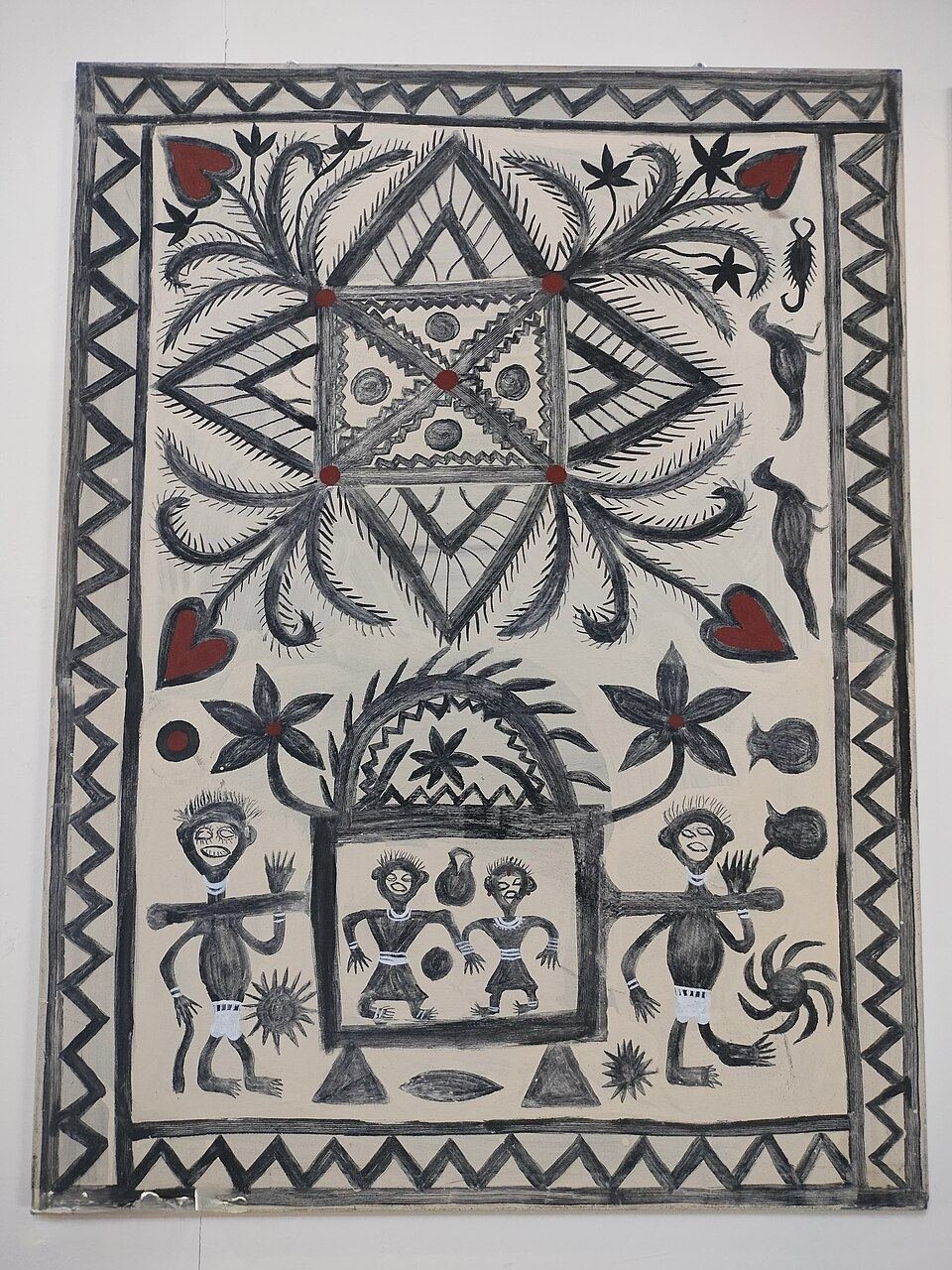
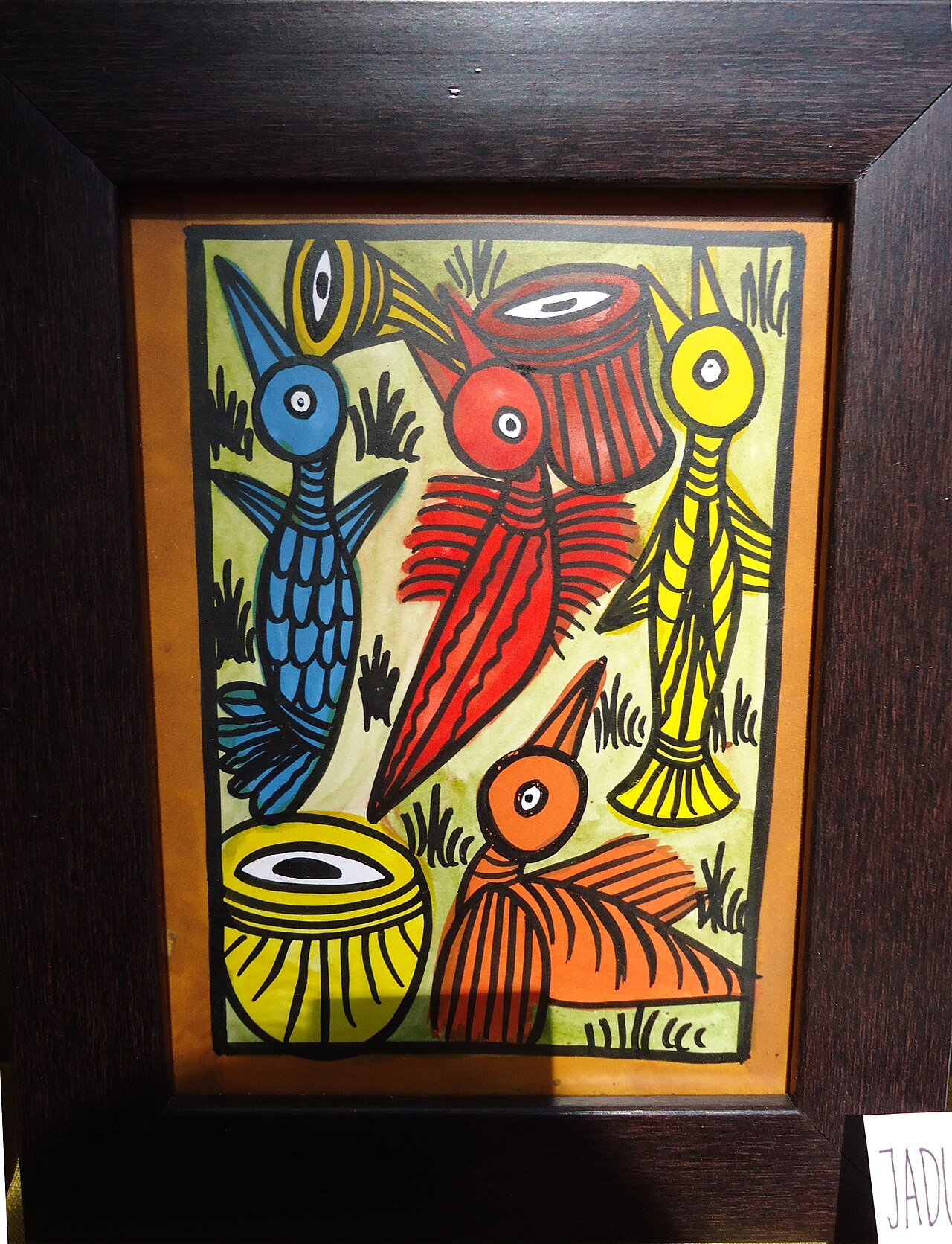
Jadopatia (Paitkar) Painting — Jharkhand
This one is worth pausing on, because it’s dying in real time. Jadopatia — from jado, magic, and patta, scroll — is a scroll-painting tradition of the Santhal community, practised by a small hereditary group of painter-bards called Jadupatuas or Chitrakars, based mainly in Dumka district. A closely related tradition from Amadubi village in East Singhbhum district goes by the name Paitkar. Both are built the same way: a long vertical scroll, unrolled section by section while a bard sings the story it illustrates, painted with pigment ground from local plants and stone.
What makes Jadopatia distinct from other scroll traditions is its purpose. Alongside stories from the Ramayana and Mahabharata, and the Santhal creation myth of Pilchu Haram and Pilchu Budhi, its most important use is funerary: when someone dies, a Jadupatua visits the grieving family with a scroll depicting the soul’s journey after death, painting in the deceased’s eyes as the final act — believed to help the soul see its way. As of recent surveys, only a handful of artists still practise it: two named Chitrakars in Dumka, and just three or four households out of forty-five in Amadubi still doing Paitkar painting. Without deliberate effort, this is a tradition that could disappear within a generation.
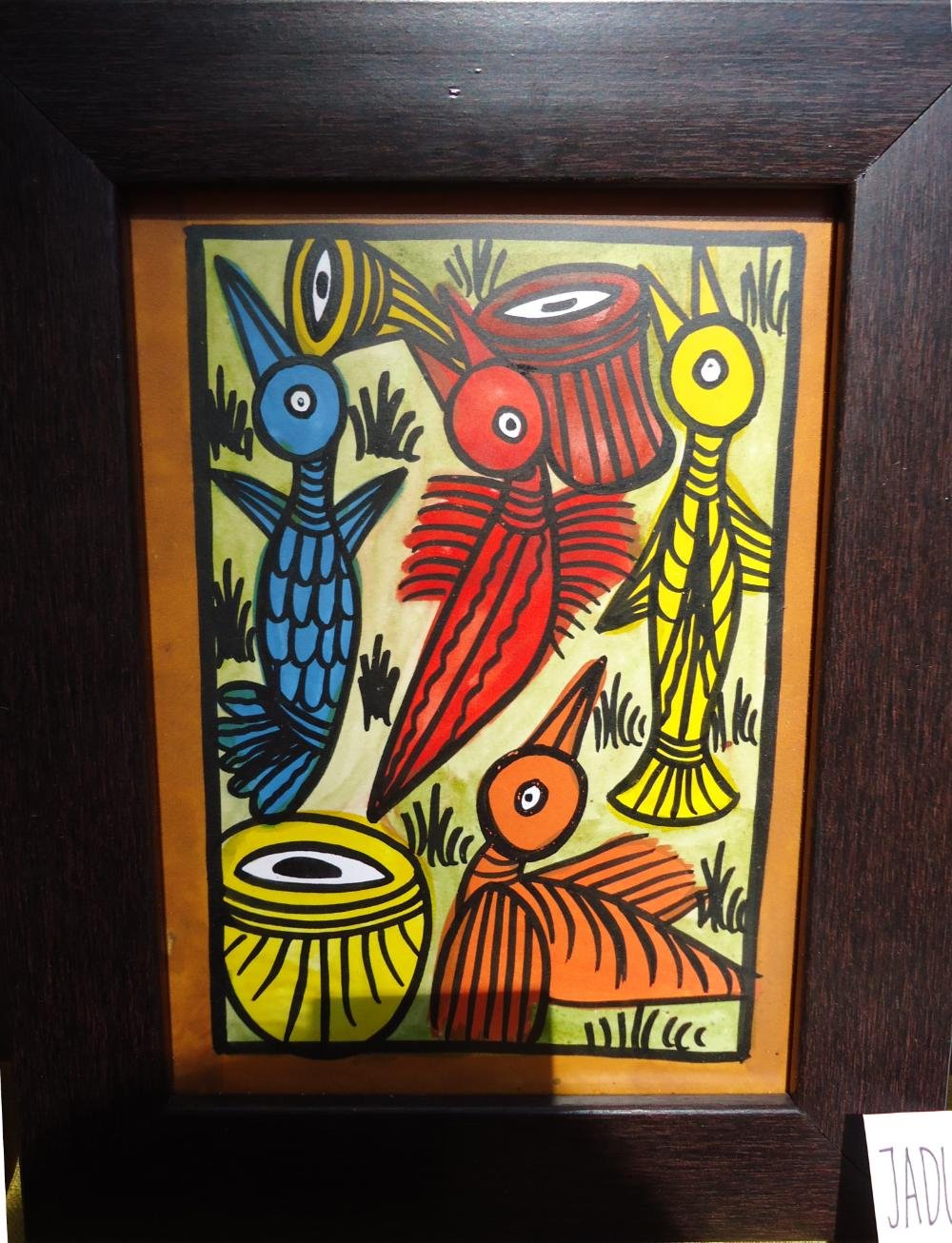
Chittara Art — Karnataka
Karnataka’s only indigenous mural folk art, Chittara is practised by women of the semi-nomadic, matrilineal Deevaru community in the Sagara, Siddapur and Honnavar taluks of Uttara Kannada and Shivamogga districts. It’s deliberately temporary — repainted fresh on home walls for weddings, naming ceremonies, housewarmings and harvest festivals like Deepavali and Nagara Panchami, rather than made to last. The palette comes entirely from what’s on hand: white from pounded rice paste mixed with white clay, red from ground stone and red mud, black from burnt rice, yellow from the seeds of the locally specific gurige tree. Figures are simplified and symbolic — brides and grooms, paddy sowing, birds and trees — built for fertility and prosperity rather than decoration.
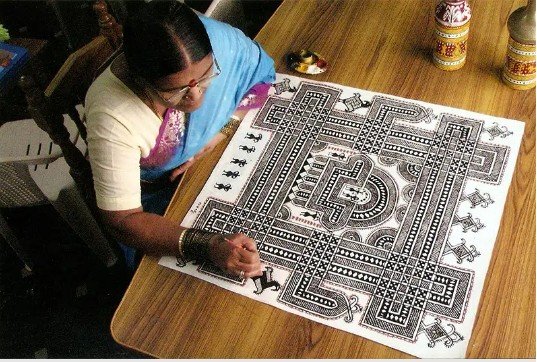
Tharu Art — Uttar Pradesh, Uttarakhand, Bihar
The Tharu live across the Terai belt straddling the India–Nepal border, with a strong presence in Uttar Pradesh’s Lakhimpur Kheri, Bahraich, Gonda and Balrampur districts. Their mural tradition, painted directly onto the mud walls of their homes using natural pigments, depicts animals, plants, daily life and episodes from epics like the Ramayana, functioning as both decoration and a way of passing down community history and belief without writing it down. It remains one of the least documented tribal painting traditions on this list outside of regional surveys and travel writing — worth watching as a candidate for more formal recognition.
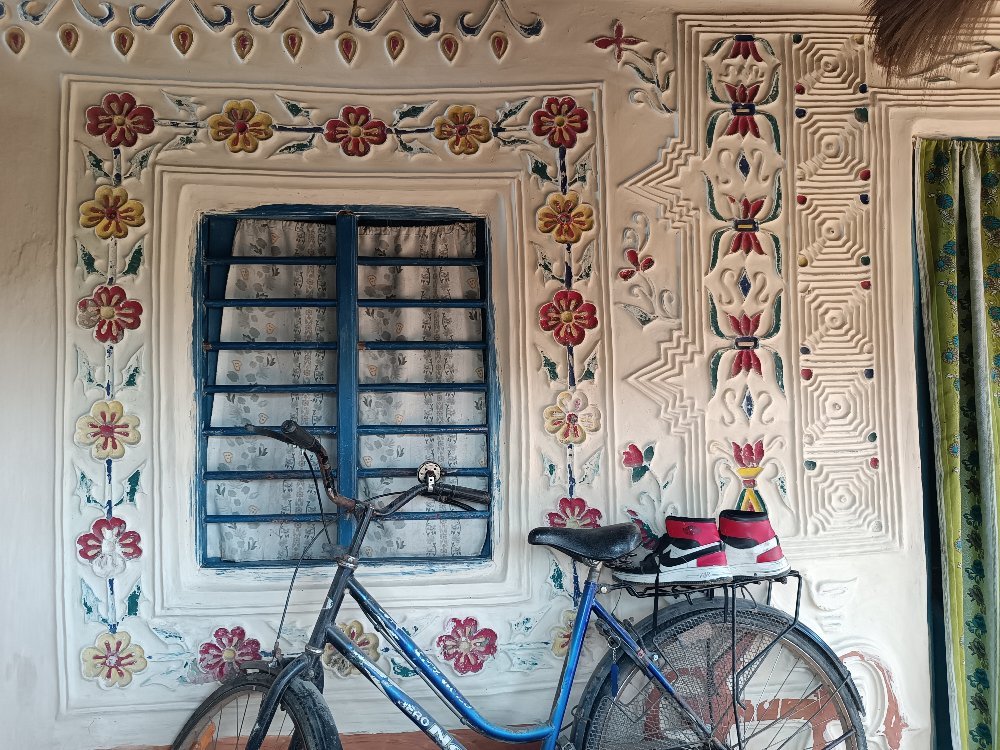
Mandana Art — Rajasthan, Madhya Pradesh
Mandana is a ritual floor-and-wall art tradition practised almost entirely by women of the Meena community, the largest tribal group in Rajasthan, found across Jaipur, Alwar, Bharatpur, Sawai Madhopur, Tonk and the Hadoti and Jhalawar regions. In Rajasthan, Meena women paint both floors and walls; in Madhya Pradesh, the same community makes only floor paintings. Walls are painted with a brush made from a date-palm twig; floor patterns are made by soaking cloth in white khadiya (chalk) paste and squeezing it out to draw with, finished by hand. The art is passed down purely by daughters watching mothers, with no formal instruction, and made only around festivals and weddings, believed to protect the home from illness and bad luck and to welcome the gods in. Like several traditions on this list, it’s reportedly in decline, as fewer daughters continue learning it from their mothers.
Beyond Painting: Tribal Craft Traditions
Painting isn’t the only medium tribal communities have used for centuries — metal, iron, bamboo, wood and thread carry just as much of this history. A few worth knowing:
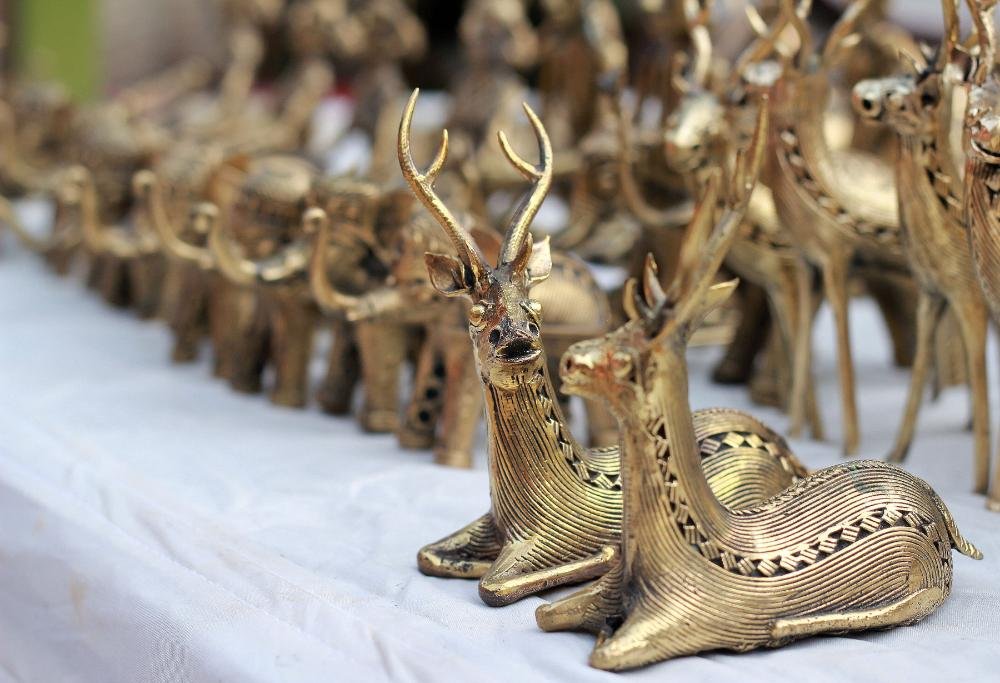
Dhokra (bell-metal casting) — Practiced by the nomadic Dhokra Damar metalsmith community across Odisha, West Bengal, Chhattisgarh and Madhya Pradesh, this is lost-wax metal casting, one of the oldest continuously practised techniques in the world — the 4,500-year-old “Dancing Girl” figurine from Mohenjo-daro was made the same way. A wax model is built, coated in clay, then fired so the wax melts out (“lost”), leaving a mould for molten brass or bronze. The result is a slightly rough, matte-finish figure — animals, deities, ritual objects — that can’t be perfectly replicated by machine casting, which is part of what makes it recognizable.
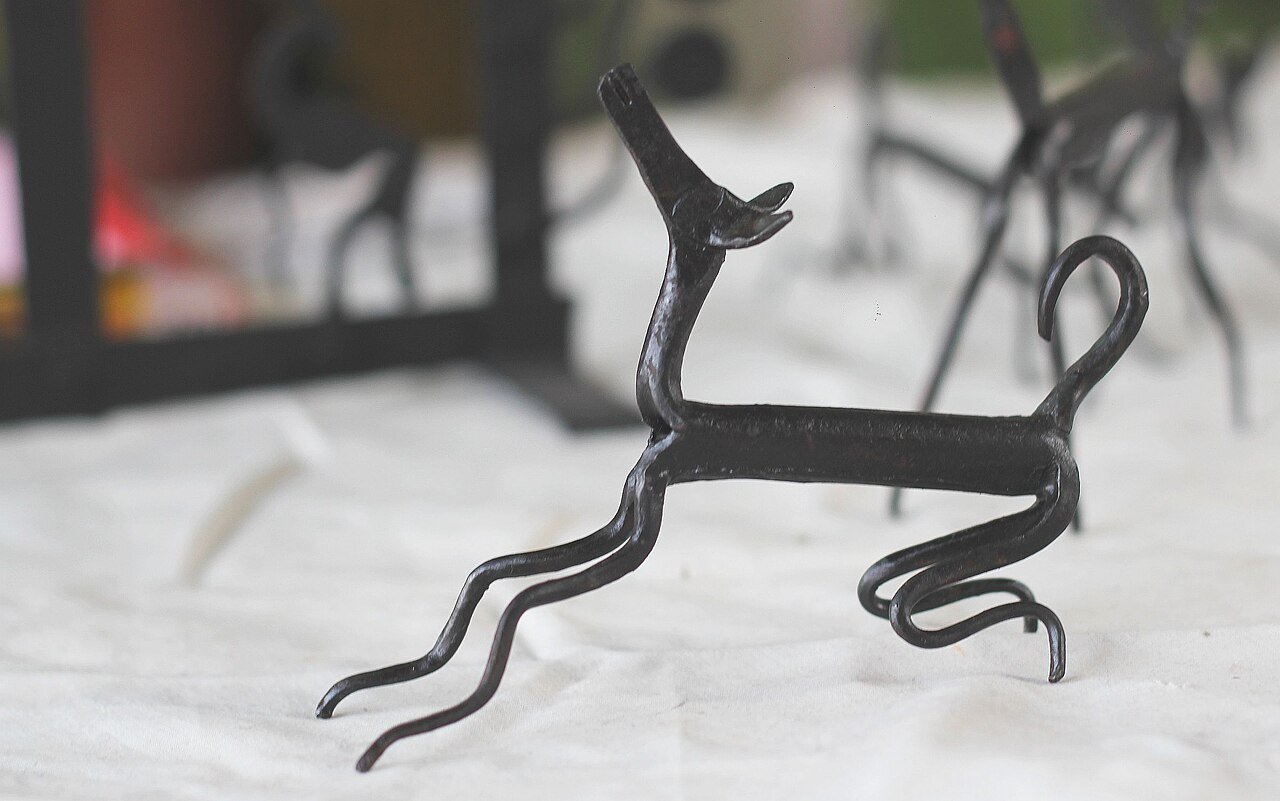
Bastar Iron Craft — Wrought iron work from Chhattisgarh’s Bastar district, centred on Kondagaon, practised originally by Gond and Maria tribes who started as tool-makers for farming and hunting. There’s no moulding involved: a smith beats and shapes hot scrap iron directly into figures and objects. GI-tagged under the Geographical Indications Act, 1999.
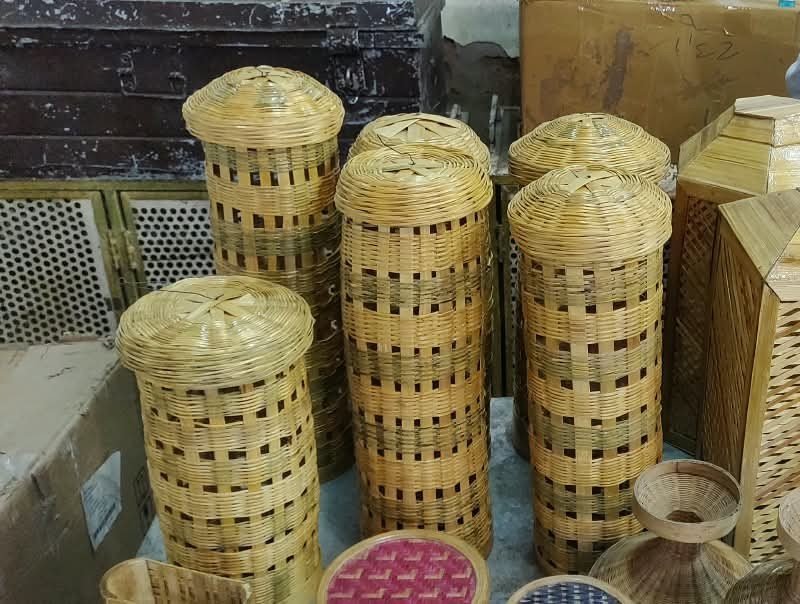
Bastar Bamboo Craft — Also GI-tagged, this covers everyday objects — baskets, trays, mats, vases — woven from bamboo and cane by Bastar’s tribal communities, prized for being fully biodegradable and worked entirely by hand.
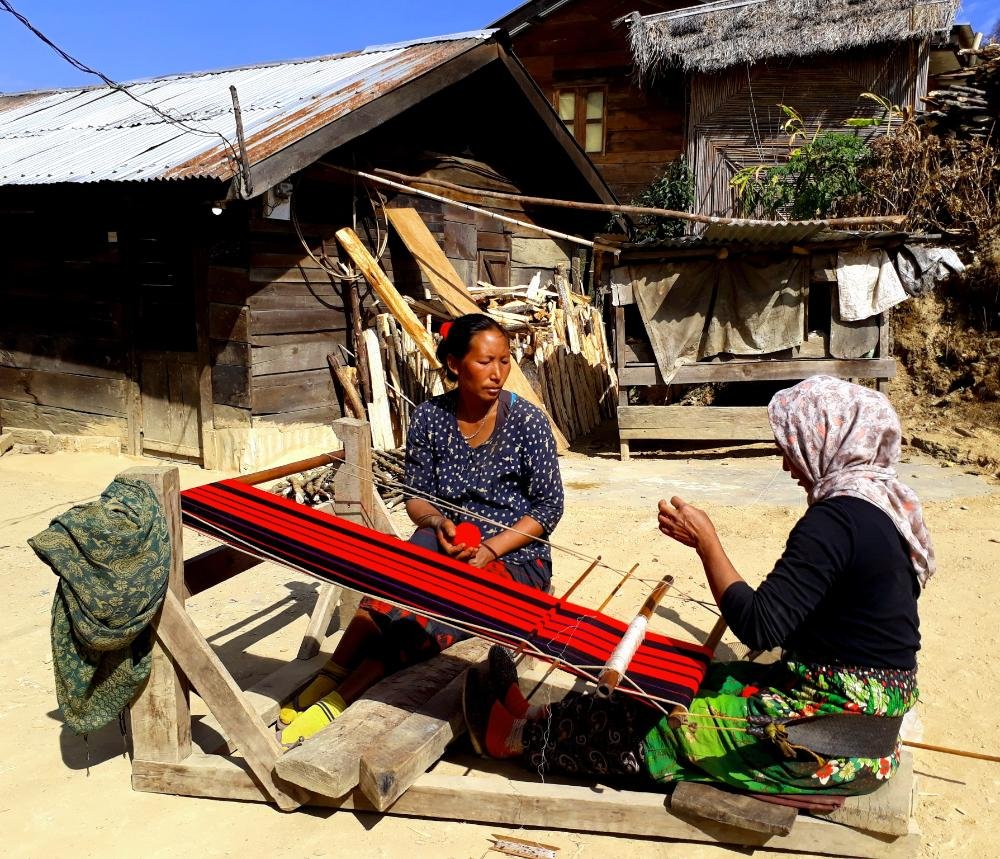
Naga Textile Weaving — Every Naga tribe in Nagaland has its own shawl patterns, woven by women on narrow loin-looms and read almost like a uniform: the Ao tribe’s Tsungkotepsu shawl carries black elephant and tiger figures on white; the Chakhesang tribe’s Khonoma shawl carries a spear motif. Historically, what you wore signalled your standing within the tribe. It’s a living tradition, but not a thriving one — fewer women take up the loin-loom each year as mainstream fashion wins out over traditional weaving.
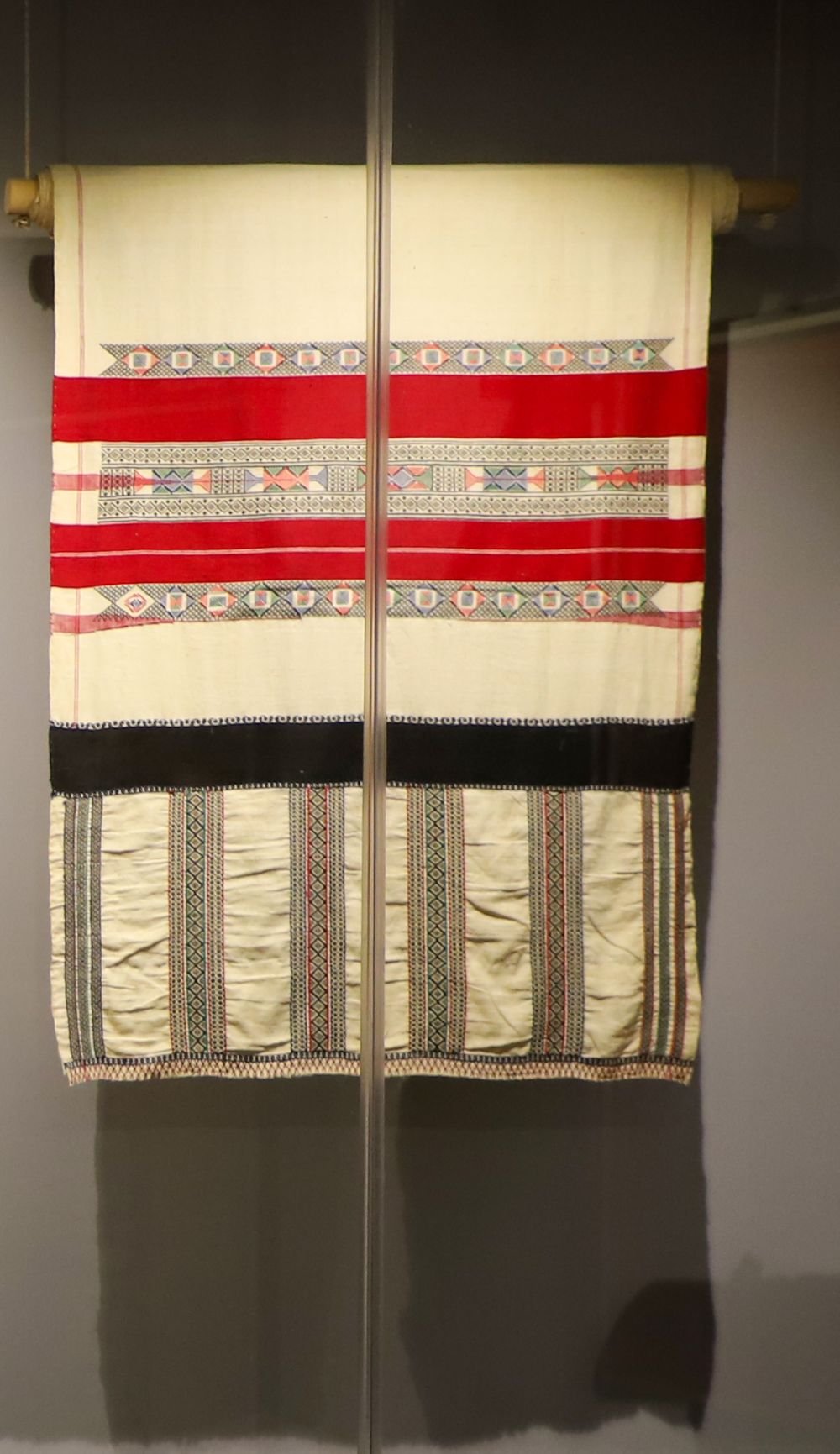
Toda Embroidery (Pukhoor) — Practiced exclusively by Toda women of the Nilgiri Hills, this is counted-thread embroidery in red and black on off-white cotton, done entirely by hand with no tracing or stencils — the pattern is worked from memory, thread by thread. There are more than 15 traditional motifs, from twehhdr pukhoor (paired pattern) to a peacock, butterfly and snake pattern. GI-tagged since 2013; legally, only Toda artisans in the Nilgiris using this counted-thread method can call their work Toda embroidery.
A Note on What’s Missing
One geography is only lightly represented on this list: Northeast India. Despite the region’s deep tribal cultures — Naga, Mizo, Rabha, Koch Rajbongshi, Debbarma, Galo and dozens more — two-dimensional mural or scroll painting simply isn’t part of most of their traditions, which is why Nagaland shows up above under weaving rather than painting. Northeastern tribal art has historically expressed itself through textiles, bamboo and cane work, woodcarving and jewellery instead of pigment on a wall. It’s a real, consistent gap in the painting side of this list, not an oversight — worth knowing rather than papering over.
Which Tribal Art Forms Are GI-Protected
A Geographical Indication (GI) tag is a legal registration confirming a craft’s name can only be used commercially by artists from its recognised home region — it’s one of the clearest signals of authenticity when you’re buying. Among the traditions covered here:
- Toda Embroidery (Tamil Nadu) — GI tag granted 2013
- Warli Painting (Maharashtra) — GI tag granted 2014
- Sohrai-Khovar Painting (Jharkhand) — GI tag granted 2020, the state’s first
- Bastar Iron Craft (Chhattisgarh) — GI-registered under the Geographical Indications Act, 1999
- Bastar Bamboo Craft (Chhattisgarh) — GI-registered
- Pithora Painting (Gujarat) — GI tag granted September 2021
- Gond Painting (Madhya Pradesh) — GI tag granted April 2023
(Madhubani painting, a folk rather than tribal tradition, was among the first to be GI-tagged, in 2007 — often listed alongside these for comparison.)
Buying Tribal Art
Because so many of these traditions now share online marketplaces, it’s easy for mass-printed reproductions to get sold under a tribal art name. A genuine piece will show small variations and imperfections from being hand-painted, will usually come with some documentation of the artist, and — for GI-protected forms — should be traceable to an artist or cooperative in the recognised region. We’ve written a longer breakdown of what to check before buying in our guide to spotting authentic Gond art.
At Tribal Art India, every piece is hand-painted to order by Gond and Bhil artists in Madhya Pradesh. Browse the full collection →
Pingback: Gond Art- Paintings that embeds nature as their soul - Tribal Art India
Pingback: Bhil Art- Pithora Art - Art of rituals and festivals - Tribal Art India